Mukesh Ram's Posts (46)

Sort by

Laravel vs Node.js: Which One is Good?

Introduction

https://miro.medium.com/v2/resize:fit:720/format:webp/0*TxBMRwaOCB1hTzFH.png 720w, https://miro.medium.com/v2/resize:fit:750/format:webp/0*TxBMRwaOCB1hTzFH.png 750w, https://miro.medium.com/v2/resize:fit:786/format:webp/0*TxBMRwaOCB1hTzFH.png 786w, https://miro.medium.com/v2/resize:fit:828/format:webp/0*TxBMRwaOCB1hTzFH.png 828w, https://miro.medium.com/v2/resize:fit:1100/format:webp/0*TxBMRwaOCB1hTzFH.png 1100w, https://miro.medium.com/v2/resize:fit:1400/format:webp/0*TxBMRwaOCB1hTzFH.png 1400w" type="image/webp" sizes="(min-resolution: 4dppx) and (max-width: 700px) 50vw, (-webkit-min-device-pixel-ratio: 4) and (max-width: 700px) 50vw, (min-resolution: 3dppx) and (max-width: 700px) 67vw, (-webkit-min-device-pixel-ratio: 3) and (max-width: 700px) 65vw, (min-resolution: 2.5dppx) and (max-width: 700px) 80vw, (-webkit-min-device-pixel-ratio: 2.5) and (max-width: 700px) 80vw, (min-resolution: 2dppx) and (max-width: 700px) 100vw, (-webkit-min-device-pixel-ratio: 2) and (max-width: 700px) 100vw, 700px" />https://miro.medium.com/v2/resize:fit:720/0*TxBMRwaOCB1hTzFH.png 720w, https://miro.medium.com/v2/resize:fit:750/0*TxBMRwaOCB1hTzFH.png 750w, https://miro.medium.com/v2/resize:fit:786/0*TxBMRwaOCB1hTzFH.png 786w, https://miro.medium.com/v2/resize:fit:828/0*TxBMRwaOCB1hTzFH.png 828w, https://miro.medium.com/v2/resize:fit:1100/0*TxBMRwaOCB1hTzFH.png 1100w, https://miro.medium.com/v2/resize:fit:1400/0*TxBMRwaOCB1hTzFH.png 1400w" sizes="(min-resolution: 4dppx) and (max-width: 700px) 50vw, (-webkit-min-device-pixel-ratio: 4) and (max-width: 700px) 50vw, (min-resolution: 3dppx) and (max-width: 700px) 67vw, (-webkit-min-device-pixel-ratio: 3) and (max-width: 700px) 65vw, (min-resolution: 2.5dppx) and (max-width: 700px) 80vw, (-webkit-min-device-pixel-ratio: 2.5) and (max-width: 700px) 80vw, (min-resolution: 2dppx) and (max-width: 700px) 100vw, (-webkit-min-device-pixel-ratio: 2) and (max-width: 700px) 100vw, 700px" data-testid="og" />
Laravel vs Node.js: Which One is Good?

Startups tend to aim for rapid market entry while large enterprises look to build a scalable system. Irrespective of which you are, the main dilemma before starting developing state-of-the-art solutions will be the selection of technology.

There are several options, but which is the best backend framework for startups and enterprises? In most cases, it tends to come down to the two most influential frameworks — Laravel and Node.js.

This isn’t an article to compare programming languages however, it is important to understand how PHP vs JavaScript backend fair. 74.2% of the websites use PHP for server-side programming and Laravel happens to be one of the most popular PHP frameworks.

Laravel is a PHP-based framework that has built a reputation for rapid development and simplicity. On the other hand, Node.js, powered by JavaScript, is hailed for its performance, scalability, and event-driven architecture.

Deciding between Laravel and Node.js isn’t merely a technical preference; it’s a strategic business decision. The goodness of each platform lies in its ability to meet your project’s unique demands, budget constraints, and scalability aspirations, directly influencing your real-world ROI.

While both technologies are powerful in their own right, they serve different purposes and cater to different use cases. This is an article about Laravel vs Node.js — a side-by-side comparison to evaluate them across several critical factors.

Quick Overview of Laravel

https://miro.medium.com/v2/resize:fit:720/format:webp/0*1TPrbL3wMwdXPTq7.png 720w, https://miro.medium.com/v2/resize:fit:750/format:webp/0*1TPrbL3wMwdXPTq7.png 750w, https://miro.medium.com/v2/resize:fit:786/format:webp/0*1TPrbL3wMwdXPTq7.png 786w, https://miro.medium.com/v2/resize:fit:828/format:webp/0*1TPrbL3wMwdXPTq7.png 828w, https://miro.medium.com/v2/resize:fit:1100/format:webp/0*1TPrbL3wMwdXPTq7.png 1100w, https://miro.medium.com/v2/resize:fit:1400/format:webp/0*1TPrbL3wMwdXPTq7.png 1400w" type="image/webp" sizes="(min-resolution: 4dppx) and (max-width: 700px) 50vw, (-webkit-min-device-pixel-ratio: 4) and (max-width: 700px) 50vw, (min-resolution: 3dppx) and (max-width: 700px) 67vw, (-webkit-min-device-pixel-ratio: 3) and (max-width: 700px) 65vw, (min-resolution: 2.5dppx) and (max-width: 700px) 80vw, (-webkit-min-device-pixel-ratio: 2.5) and (max-width: 700px) 80vw, (min-resolution: 2dppx) and (max-width: 700px) 100vw, (-webkit-min-device-pixel-ratio: 2) and (max-width: 700px) 100vw, 700px" />https://miro.medium.com/v2/resize:fit:720/0*1TPrbL3wMwdXPTq7.png 720w, https://miro.medium.com/v2/resize:fit:750/0*1TPrbL3wMwdXPTq7.png 750w, https://miro.medium.com/v2/resize:fit:786/0*1TPrbL3wMwdXPTq7.png 786w, https://miro.medium.com/v2/resize:fit:828/0*1TPrbL3wMwdXPTq7.png 828w, https://miro.medium.com/v2/resize:fit:1100/0*1TPrbL3wMwdXPTq7.png 1100w, https://miro.medium.com/v2/resize:fit:1400/0*1TPrbL3wMwdXPTq7.png 1400w" sizes="(min-resolution: 4dppx) and (max-width: 700px) 50vw, (-webkit-min-device-pixel-ratio: 4) and (max-width: 700px) 50vw, (min-resolution: 3dppx) and (max-width: 700px) 67vw, (-webkit-min-device-pixel-ratio: 3) and (max-width: 700px) 65vw, (min-resolution: 2.5dppx) and (max-width: 700px) 80vw, (-webkit-min-device-pixel-ratio: 2.5) and (max-width: 700px) 80vw, (min-resolution: 2dppx) and (max-width: 700px) 100vw, (-webkit-min-device-pixel-ratio: 2) and (max-width: 700px) 100vw, 700px" data-testid="og" />
Quick Overview of Laravel

Laravel is more than just a PHP framework; it represents the modern face of PHP development. Laravel is a robust, open-source PHP framework built around the Model-View-Controller (MVC) architecture. It provides built-in tools such as Eloquent ORM, Blade templating, authentication scaffolding, and Artisan CLI to simplify development workflows.

Hence the obvious question: Is Laravel better than Node.js for web development?. The following sections will make this more evident.

There are many Laravel pros and cons, but here are it’s core philosophy and strengths:

  • Developer Experience (DX) First
  • Model-View-Controller (MVC) Architecture
  • Feature-rich out-of-the-box
  • Eloquent ORM
  • Blade Templating Engine
  • Artisan CLI
  • Built-in Authentication & Authorization
  • Caching & Queues
  • Testing Utilities
  • Maturity and Stability
  • Vibrant and Supportive Ecosystem
  • Laravel applications scale effectively

There are many benefits of using Laravel since it is a feature-rich platform with built-in security. It is ideal to build high-performing applications.

Understanding What is Node.js

https://miro.medium.com/v2/resize:fit:720/format:webp/0*yHV_IhS85SjIPbmR.png 720w, https://miro.medium.com/v2/resize:fit:750/format:webp/0*yHV_IhS85SjIPbmR.png 750w, https://miro.medium.com/v2/resize:fit:786/format:webp/0*yHV_IhS85SjIPbmR.png 786w, https://miro.medium.com/v2/resize:fit:828/format:webp/0*yHV_IhS85SjIPbmR.png 828w, https://miro.medium.com/v2/resize:fit:1100/format:webp/0*yHV_IhS85SjIPbmR.png 1100w, https://miro.medium.com/v2/resize:fit:1400/format:webp/0*yHV_IhS85SjIPbmR.png 1400w" type="image/webp" sizes="(min-resolution: 4dppx) and (max-width: 700px) 50vw, (-webkit-min-device-pixel-ratio: 4) and (max-width: 700px) 50vw, (min-resolution: 3dppx) and (max-width: 700px) 67vw, (-webkit-min-device-pixel-ratio: 3) and (max-width: 700px) 65vw, (min-resolution: 2.5dppx) and (max-width: 700px) 80vw, (-webkit-min-device-pixel-ratio: 2.5) and (max-width: 700px) 80vw, (min-resolution: 2dppx) and (max-width: 700px) 100vw, (-webkit-min-device-pixel-ratio: 2) and (max-width: 700px) 100vw, 700px" />https://miro.medium.com/v2/resize:fit:720/0*yHV_IhS85SjIPbmR.png 720w, https://miro.medium.com/v2/resize:fit:750/0*yHV_IhS85SjIPbmR.png 750w, https://miro.medium.com/v2/resize:fit:786/0*yHV_IhS85SjIPbmR.png 786w, https://miro.medium.com/v2/resize:fit:828/0*yHV_IhS85SjIPbmR.png 828w, https://miro.medium.com/v2/resize:fit:1100/0*yHV_IhS85SjIPbmR.png 1100w, https://miro.medium.com/v2/resize:fit:1400/0*yHV_IhS85SjIPbmR.png 1400w" sizes="(min-resolution: 4dppx) and (max-width: 700px) 50vw, (-webkit-min-device-pixel-ratio: 4) and (max-width: 700px) 50vw, (min-resolution: 3dppx) and (max-width: 700px) 67vw, (-webkit-min-device-pixel-ratio: 3) and (max-width: 700px) 65vw, (min-resolution: 2.5dppx) and (max-width: 700px) 80vw, (-webkit-min-device-pixel-ratio: 2.5) and (max-width: 700px) 80vw, (min-resolution: 2dppx) and (max-width: 700px) 100vw, (-webkit-min-device-pixel-ratio: 2) and (max-width: 700px) 100vw, 700px" data-testid="og" />
Understanding What is Node.js

Developers use Node.js not as a framework, but as a runtime environment for JavaScript powered by Chrome’s V8 engine. Its breakthrough came when it allowed JavaScript to move beyond the browser, letting teams build both frontend and backend with one language.

By operating on an event-driven, non-blocking I/O model, Node.js handles real-time data and high volumes of simultaneous connections with impressive efficiency.

There are many benefits of using Node.js, however here are its core strengths:

  • Asynchronous, Non-Blocking I/O
  • NPM (Node Package Manager) Ecosystem
  • Ideal for APIs and Microservices
  • Real-Time Capabilities
  • Serverless Potential

Node.js performance advantages in several use cases can work in your favor.

Popular Node.js Frameworks That Bring Structure to the Chaos

Although Node.js itself isn’t a framework, it uses the JavaScript programming language. There are several JavaScript frameworks that allow one to build a full-fledged application. Here are a few standout choices that have become favorites in the community:

  • Express.js: Think of Express as the lean, no-frills framework that gets out of your way. It doesn’t tell you how to build — just hands you the tools and lets you run with them. Loved for its simplicity and flexibility, Express powers everything from small side projects to large-scale applications.
  • NestJS: If you’re building something complex and want structure from day one, NestJS steps in like an architect with a blueprint. Inspired by Angular and built with TypeScript at its core, it brings dependency injection, modular design, and enterprise-ready features that help teams stay organized as projects grow.
  • Koa.js: Created by the same team behind Express, Koa is the modern minimalist. It uses ES6’s async/await to give developers finer control over asynchronous flows, cutting down on callback clutter and improving code readability. It’s perfect for those who want the power of Node with a cleaner, more elegant approach.

Use Case Comparisons

Choosing backend technology is a task for someone with sufficient technical knowledge. It is an important decision that can dictate the outcome of your project.

This Laravel vs Node.js overview of the user cases will make this decision easier. Laravel is a full-stack PHP framework that is ideal for the rapid development of secure, high-performing, and scalable applications. This makes it ideal for developing enterprise applications, content-driven platforms, eCommerce applications, SaaS solutions, and much more.

NodeJS is a JavaScript runtime library with immense potential. It is well suited for developing real-time, event-driven, and high-concurrency applications. This means it is one of the best options when it comes to developing a chat application, messaging app, single page application, and IoT application. Hence it is vital to consider Node.JS when doing a backend technology comparison with use cases.

Laravel vs Node.js — compassion of the use cases:

https://miro.medium.com/v2/resize:fit:720/format:webp/1*ir1pIVsyWWViwqhrkG9x3w.png 720w, https://miro.medium.com/v2/resize:fit:750/format:webp/1*ir1pIVsyWWViwqhrkG9x3w.png 750w, https://miro.medium.com/v2/resize:fit:786/format:webp/1*ir1pIVsyWWViwqhrkG9x3w.png 786w, https://miro.medium.com/v2/resize:fit:828/format:webp/1*ir1pIVsyWWViwqhrkG9x3w.png 828w, https://miro.medium.com/v2/resize:fit:1100/format:webp/1*ir1pIVsyWWViwqhrkG9x3w.png 1100w, https://miro.medium.com/v2/resize:fit:1400/format:webp/1*ir1pIVsyWWViwqhrkG9x3w.png 1400w" type="image/webp" sizes="(min-resolution: 4dppx) and (max-width: 700px) 50vw, (-webkit-min-device-pixel-ratio: 4) and (max-width: 700px) 50vw, (min-resolution: 3dppx) and (max-width: 700px) 67vw, (-webkit-min-device-pixel-ratio: 3) and (max-width: 700px) 65vw, (min-resolution: 2.5dppx) and (max-width: 700px) 80vw, (-webkit-min-device-pixel-ratio: 2.5) and (max-width: 700px) 80vw, (min-resolution: 2dppx) and (max-width: 700px) 100vw, (-webkit-min-device-pixel-ratio: 2) and (max-width: 700px) 100vw, 700px" />https://miro.medium.com/v2/resize:fit:720/1*ir1pIVsyWWViwqhrkG9x3w.png 720w, https://miro.medium.com/v2/resize:fit:750/1*ir1pIVsyWWViwqhrkG9x3w.png 750w, https://miro.medium.com/v2/resize:fit:786/1*ir1pIVsyWWViwqhrkG9x3w.png 786w, https://miro.medium.com/v2/resize:fit:828/1*ir1pIVsyWWViwqhrkG9x3w.png 828w, https://miro.medium.com/v2/resize:fit:1100/1*ir1pIVsyWWViwqhrkG9x3w.png 1100w, https://miro.medium.com/v2/resize:fit:1400/1*ir1pIVsyWWViwqhrkG9x3w.png 1400w" sizes="(min-resolution: 4dppx) and (max-width: 700px) 50vw, (-webkit-min-device-pixel-ratio: 4) and (max-width: 700px) 50vw, (min-resolution: 3dppx) and (max-width: 700px) 67vw, (-webkit-min-device-pixel-ratio: 3) and (max-width: 700px) 65vw, (min-resolution: 2.5dppx) and (max-width: 700px) 80vw, (-webkit-min-device-pixel-ratio: 2.5) and (max-width: 700px) 80vw, (min-resolution: 2dppx) and (max-width: 700px) 100vw, (-webkit-min-device-pixel-ratio: 2) and (max-width: 700px) 100vw, 700px" data-testid="og" />
Laravel vs Node.js — compassion of the use cases:

Here are some of the best use cases for Laravel:

  • On-demand apps
  • eLearning apps
  • Stock trading solutions
  • Multilingual CMS system
  • Banking & Fintech apps
  • Gaming apps
  • Music & Video streaming apps
  • Chat, Messaging, and Email apps

Here are some of the best use cases for Node.js:

  • Real-time chat apps
  • Complex SPAs
  • Embedded systems
  • Data streaming apps
  • Transportation and logistic apps
  • Browser games

Head-to-Head Comparison

https://miro.medium.com/v2/resize:fit:720/format:webp/0*P11XEqw70GqX72Xz.png 720w, https://miro.medium.com/v2/resize:fit:750/format:webp/0*P11XEqw70GqX72Xz.png 750w, https://miro.medium.com/v2/resize:fit:786/format:webp/0*P11XEqw70GqX72Xz.png 786w, https://miro.medium.com/v2/resize:fit:828/format:webp/0*P11XEqw70GqX72Xz.png 828w, https://miro.medium.com/v2/resize:fit:1100/format:webp/0*P11XEqw70GqX72Xz.png 1100w, https://miro.medium.com/v2/resize:fit:1400/format:webp/0*P11XEqw70GqX72Xz.png 1400w" type="image/webp" sizes="(min-resolution: 4dppx) and (max-width: 700px) 50vw, (-webkit-min-device-pixel-ratio: 4) and (max-width: 700px) 50vw, (min-resolution: 3dppx) and (max-width: 700px) 67vw, (-webkit-min-device-pixel-ratio: 3) and (max-width: 700px) 65vw, (min-resolution: 2.5dppx) and (max-width: 700px) 80vw, (-webkit-min-device-pixel-ratio: 2.5) and (max-width: 700px) 80vw, (min-resolution: 2dppx) and (max-width: 700px) 100vw, (-webkit-min-device-pixel-ratio: 2) and (max-width: 700px) 100vw, 700px" />https://miro.medium.com/v2/resize:fit:720/0*P11XEqw70GqX72Xz.png 720w, https://miro.medium.com/v2/resize:fit:750/0*P11XEqw70GqX72Xz.png 750w, https://miro.medium.com/v2/resize:fit:786/0*P11XEqw70GqX72Xz.png 786w, https://miro.medium.com/v2/resize:fit:828/0*P11XEqw70GqX72Xz.png 828w, https://miro.medium.com/v2/resize:fit:1100/0*P11XEqw70GqX72Xz.png 1100w, https://miro.medium.com/v2/resize:fit:1400/0*P11XEqw70GqX72Xz.png 1400w" sizes="(min-resolution: 4dppx) and (max-width: 700px) 50vw, (-webkit-min-device-pixel-ratio: 4) and (max-width: 700px) 50vw, (min-resolution: 3dppx) and (max-width: 700px) 67vw, (-webkit-min-device-pixel-ratio: 3) and (max-width: 700px) 65vw, (min-resolution: 2.5dppx) and (max-width: 700px) 80vw, (-webkit-min-device-pixel-ratio: 2.5) and (max-width: 700px) 80vw, (min-resolution: 2dppx) and (max-width: 700px) 100vw, (-webkit-min-device-pixel-ratio: 2) and (max-width: 700px) 100vw, 700px" data-testid="og" />

Head-to-Head Comparison

The previous sections give a good overview of both Laravel and Node.js. Hence it is time for a detailed comparison of Laravel vs Node.js:

Language Base & Learning Curve:

  • Laravel: Laravel’s opinionated structure and extensive documentation make it beginner-friendly and ideal for teams needing quick onboarding. However, it does require one to have intermediate experience with programming in PHP. Laravel’s gentle learning curve is a major plus for fast-moving teams.
  • Node.js: Node.js enables full-stack development with a single language — JavaScript However, developers must grasp asynchronous patterns, which can steepen the learning curve. Good knowledge of JavaScript, and a good understanding of the Node’s architecture and NPM package modules can help reduce the learning curve. Node.js offers flexibility but demands discipline and experienced developers to maintain structure.

Laravel vs Node.js Performance Comparison:

  • Laravel: Laravel, built on a synchronous PHP runtime, may lag in high-concurrency use cases. However, performance bottlenecks can be addressed with Laravel Octane, Swoole, or RoadRunner for asynchronous handling. Laravel works well for high-logic business applications that aren’t real-time intensive.
  • Node.js: Node.js’s non-blocking architecture supports concurrency, making it perfect for I/O-heavy tasks like chat apps, live data feeds, and APIs. It scales horizontally with ease and performs exceptionally in high-traffic conditions. Node.js handles real-time, scalable applications efficiently. Hence Node.js scalability is an advantage.

Ecosystem & Libraries:

  • Laravel: Laravel boasts an integrated ecosystem. Tools like Horizon (queues), Echo (broadcasting), and Scout (search) provide robust features without relying on third-party libraries. Thus, Laravel reduces time-to-market with integrated tools.
  • Node.js: npm offers a vast number of packages for almost every functionality. However, it’s more unstructured and can lead to fragmented architecture if not managed properly. Node.js offers extensive flexibility for large-scale, microservice-driven systems.

Development Speed & Productivity:

  • Laravel: Laravel is designed for rapid application development. Features like built-in auth, migrations and elegant routing simplify repetitive tasks. It’s great for building SaaS products, internal tools, and CMS platforms. Laravel is better suited for MVPs and fast iteration cycles.
  • Node.js: While Node.js offers flexibility, setting up projects can take more time. Frameworks like NestJS or Express can streamline development but still require configuration and boilerplate. Node.js allows for customizable architecture suited for complex business needs.

Security & Compliance:

  • Laravel: Laravel comes equipped with built-in protection against common web threats like CSRF, XSS, and SQL injection. It also provides password hashing, authentication, and user session handling out of the box. Laravel offers stronger defaults. Node.js requires thorough DevSecOps policies. Laravel security practices work in your favor.
  • Node.js: Node.js security measures depend heavily on chosen libraries. Tools like Helmet and CSURF offer protection, but developers must be proactive in applying security best practices.

Community, Talent Pool & Hiring:

  • Laravel: Laravel has a strong presence in South Asia, Eastern Europe, and Latin America. Developers are widely available and often more cost-effective. Laravel-focused agencies and marketplaces also exist. Laravel is budget-friendly and widely supported.
  • Node.js: JavaScript’s popularity makes Node.js developers easy to find. Full-stack JavaScript developers are in high demand, especially in North America and Europe. Node.js has a larger, more versatile talent pool.

Cost of Development & Maintenance

  • Laravel: Development with Laravel is cost-effective due to faster development cycles and a large pool of affordable developers. Its structured nature also ensures lower maintenance overhead. The cost to develop Laravel apps makes it ideal for short-time-to-market goals.
  • Node.js: Initial development may cost more due to complex setups. However, the cost to develop Node.js app can be lower for large-scale deployments if maintained well. Node.js offers better long-term scalability for high-performance apps.

Startups & Enterprises

  • Laravel: Laravel is the ideal choice for startups seeking to build and ship fast. The Laravel ecosystem and built-in tools help reduce development time and costs. Laravel remains a strong contender for enterprise-grade CRUD applications, compliance platforms, and ERP systems.
  • Node.js: Node.js should be considered when real-time or data-heavy applications are involved. Node.js is excellent for scalable microservices and real-time systems but demands robust DevOps and architecture oversight.

Communication:

  • Laravel: Laravel is designed with a well-defined structure that promotes good coding practices. At the same time, it also equips the developers with high-level control and lets them experiment. This makes Laravel highly customizable however, it requires one to have extensive knowledge of PHP in order to do so.
  • Node.js: Node.js is also open-source thus allowing one to customize the package modules. It allows the developers to customize as per their requirements.

Laravel vs Node.js Feature Comparison

When choosing between Laravel and Node.js, it’s not just about the language — it’s about philosophy, structure, and how each tool helps you deliver better software faster. Let’s explore how these two powerhouses stack up, feature by feature.

The Laravel vs Node.js feature-by-feature breakdown:

Laravel: Elegance Meets Efficiency

Laravel isn’t just another PHP framework — it’s a carefully crafted ecosystem designed to make your life easier as a developer. It emphasizes clarity, structure, and developer happiness, and it comes packed with features that reduce the need for boilerplate code and repetitive tasks.

MVC Architecture That Keeps You Organized

Laravel’s Model-View-Controller (MVC) structure brings a clean separation of logic, data, and presentation. This design pattern keeps your application maintainable and scalable — even as your codebase grows.

Eloquent ORM: Talk to Your Database Like a Pro

Working with databases in Laravel feels almost natural. Eloquent lets you treat tables as objects and simplifies complex relationships with expressive syntax, making CRUD operations feel intuitive.

Queue System: Offload the Heavy Lifting

Whether you’re sending thousands of emails or processing massive image files, Laravel’s built-in queue system lets you push those time-consuming tasks to the background — speeding up the user experience without sacrificing performance.

Security, Baked In

From CSRF protection to hashed passwords and built-in sanitization, Laravel ships with robust security already wired into its core — saving you hours of research and implementation.

Routing That Makes Sense

Laravel’s elegant routing syntax helps define clear URL paths and lets you attach middleware (like authentication or logging) right at the entry point — so you control traffic before it hits your controllers.

First-Class Testing Support

Laravel promotes test-driven development (TDD) by offering built-in tools for unit, feature, and browser testing. If stability and continuous delivery matter to you, Laravel has your back.

Broadcasting & Real-Time Updates, Simplified

With Laravel Broadcasting and Echo, integrating real-time features like notifications or collaborative tools becomes seamless. No more complex WebSocket setups — just elegant APIs that work.

Laravel Octane: Performance on Steroids

Looking to push PHP beyond its limits? Octane uses high-performance servers like Swoole to dramatically boost Laravel’s speed. It brings concurrency, coroutines, and async behavior — something PHP wasn’t traditionally known for — right into your app stack.

Node.js: Powering Full-Stack JavaScript

Node.js isn’t a framework — it’s a runtime environment that redefined backend development by letting JavaScript run server-side. Lightweight, non-blocking, and asynchronous by design, Node.js is the engine behind many of today’s most demanding, real-time applications.

Asynchronous, Non-Blocking I/O for the Win

Node handles thousands of simultaneous connections with ease. Its event-driven nature makes it ideal for chat apps, live feeds, and APIs that demand real-time responsiveness.

Blazing Speed with V8 Engine

Powered by Google’s V8 engine, Node compiles JavaScript to machine code on the fly — giving your backend an impressive performance boost, especially for compute-light workloads.

Single-Threaded, Yet Super Scalable

Although it runs on a single thread, Node can handle massive traffic. For heavier, CPU-bound tasks, you can offload processing to worker threads or scale horizontally with ease.

NPM: The World’s Largest Developer Toolbox

With access to over a million open-source packages, NPM (Node Package Manager) makes it easy to plug in pre-built modules — whether you’re spinning up a REST API or adding OAuth support.

JavaScript All the Way Down

Using the same language across frontend and backend simplifies collaboration, reduces context switching, and makes it easier to hire or upskill developers in full-stack roles.

Perfect for Microservices and APIs

Node’s modular design and lightweight footprint make it a natural fit for building microservices architectures, allowing teams to scale and deploy independently without stepping on each other’s toes.

Real-Time Application Ready

Need WebSockets, live updates, or streaming capabilities? Node.js shines in building fast, two-way communication systems — whether it’s multiplayer gaming, collaborative tools, or financial dashboards.

Handles Streams Like a Native

From processing large video files to piping data through analytics engines, Node’s stream API allows you to work with big data efficiently, minimizing memory usage and boosting performance.

Runs Anywhere, Deploys Everywhere

With cross-platform support baked in, Node applications can be developed on macOS and deployed on Linux or Windows with minimal friction — an essential advantage for today’s cloud-native workflows.

Real-World Examples

https://miro.medium.com/v2/resize:fit:720/format:webp/0*STA3oIA9tL2U8i9f.png 720w, https://miro.medium.com/v2/resize:fit:750/format:webp/0*STA3oIA9tL2U8i9f.png 750w, https://miro.medium.com/v2/resize:fit:786/format:webp/0*STA3oIA9tL2U8i9f.png 786w, https://miro.medium.com/v2/resize:fit:828/format:webp/0*STA3oIA9tL2U8i9f.png 828w, https://miro.medium.com/v2/resize:fit:1100/format:webp/0*STA3oIA9tL2U8i9f.png 1100w, https://miro.medium.com/v2/resize:fit:1400/format:webp/0*STA3oIA9tL2U8i9f.png 1400w" type="image/webp" sizes="(min-resolution: 4dppx) and (max-width: 700px) 50vw, (-webkit-min-device-pixel-ratio: 4) and (max-width: 700px) 50vw, (min-resolution: 3dppx) and (max-width: 700px) 67vw, (-webkit-min-device-pixel-ratio: 3) and (max-width: 700px) 65vw, (min-resolution: 2.5dppx) and (max-width: 700px) 80vw, (-webkit-min-device-pixel-ratio: 2.5) and (max-width: 700px) 80vw, (min-resolution: 2dppx) and (max-width: 700px) 100vw, (-webkit-min-device-pixel-ratio: 2) and (max-width: 700px) 100vw, 700px" />https://miro.medium.com/v2/resize:fit:720/0*STA3oIA9tL2U8i9f.png 720w, https://miro.medium.com/v2/resize:fit:750/0*STA3oIA9tL2U8i9f.png 750w, https://miro.medium.com/v2/resize:fit:786/0*STA3oIA9tL2U8i9f.png 786w, https://miro.medium.com/v2/resize:fit:828/0*STA3oIA9tL2U8i9f.png 828w, https://miro.medium.com/v2/resize:fit:1100/0*STA3oIA9tL2U8i9f.png 1100w, https://miro.medium.com/v2/resize:fit:1400/0*STA3oIA9tL2U8i9f.png 1400w" sizes="(min-resolution: 4dppx) and (max-width: 700px) 50vw, (-webkit-min-device-pixel-ratio: 4) and (max-width: 700px) 50vw, (min-resolution: 3dppx) and (max-width: 700px) 67vw, (-webkit-min-device-pixel-ratio: 3) and (max-width: 700px) 65vw, (min-resolution: 2.5dppx) and (max-width: 700px) 80vw, (-webkit-min-device-pixel-ratio: 2.5) and (max-width: 700px) 80vw, (min-resolution: 2dppx) and (max-width: 700px) 100vw, (-webkit-min-device-pixel-ratio: 2) and (max-width: 700px) 100vw, 700px" data-testid="og" />

Real-World Examples

In the fast-paced startup world, the ‘good’ technology choice — be it Laravel or Node.js — isn’t about absolute speed, but about strategic alignment. Your ability to scale effectively hinges on understanding when each platform truly serves your evolving needs, ensuring sustainable growth over time. Here are a few real-world examples of Laravel and Node.js to help with the decision process.

Laravel: Laravel is the choice of many different companies around the world. This includes firms like BBC, Pfizer, 9GAG, TourRadar, Novell, Inc. and many more. Here are a few case studies:

Invoice Ninja:

  • Industry: SaaS / Invoicing
  • Use Case: Online invoice creation, time tracking, payment integration
  • Why Laravel: Secure multi-tenant system, powerful API backend, seamless integration with payment gateways.
  • Tech Highlights: Laravel’s elegant syntax, queues, and mail support power a scalable solution.
  • Link: https://www.invoiceninja.com

MyRank:

  • Industry: EdTech
  • Use Case: Competitive exam preparation platform with quizzes, reports, and performance analytics.
  • Why Laravel: Easy routing, performance optimizations with caching, and support for complex backend logic.
  • Link: https://www.myrank.in

Laracasts:

  • Industry: Online education (Developer training)
  • Use Case: Streaming video platform for Laravel and general PHP training.
  • Why Laravel: Built by Jeffrey Way (a Laravel contributor), it uses Laravel’s routing, authentication, and custom services extensively.
  • Link: https://laracasts.com

Cachet:

  • Industry: DevOps / Infrastructure
  • Use Case: Open-source status page system.
  • Why Laravel: Quick development cycles, elegant RESTful structure, user-friendly admin dashboards.
  • Link: https://cachethq.io

OctoberCMS

  • Industry: CMS / Web Development
  • Use Case: Content management platform used by developers and agencies.
  • Why Laravel: Leverages Laravel’s MVC architecture, ORM, and plugin ecosystem.
  • Link: https://octobercms.com

Great Colorado Homes

  • Industry: Real Estate / Web Development
  • Use Case: Real estate portal for both property buyers and sellers with several additional features.
  • Why Laravel: Acquaint Softtech developed with Laravel to leverage the built-in features for a dynamic real estate listing, property tour, robust property listing & search, and high performing third-party integration.
  • Link: https://greatcoloradohomes.com/

Node.js: This is a popular framework trusted by many large firms worldwide. Some of the industry’s leading companies that implement Node.js include Twitter, Spotify, eBay, Airbnb, Walmart and many more. Here are a few strategically selected case studies:

LinkedIn (Mobile Backend):

  • Industry: Professional Networking
  • Use Case: Backend API for mobile apps
  • Why Node.js: Switched from Ruby on Rails to Node.js for 2–10x performance improvements and better mobile scaling.
  • Link: LinkedIn

Netflix:

  • Industry: Streaming / Entertainment
  • Use Case: Server-side rendering, UI customization layer
  • Why Node.js: Non-blocking I/O for real-time data, fast iteration cycles, and unified JS stack for frontend + backend.
  • Link: Netflix

PayPal:

  • Industry: FinTech / Payments
  • Use Case: Web application backend
  • Why Node.js: Switched from Java to Node.js, resulting in 2x faster response times and a unified dev team for browser/server logic.
  • Link: PayPal

Uber:

  • Industry: Ride-sharing
  • Use Case: Real-time data processing, dispatch system
  • Why Node.js: Asynchronous processing, event-driven architecture suited for high I/O throughput and fast iteration.
  • Link: Uber Engineering Blog

Trello:

  • Industry: Productivity / Project Management
  • Use Case: Real-time collaboration platform
  • Why Node.js: WebSockets and event-based architecture for updating project boards in real-time.
  • Link: Trello

SuperFi

  • Industry: Fintech / Web & Mobile App
  • Use Case: A debt solution platform for users to clear their bills and gain rewards.
  • Why Node.js: Acquaint Softtech chose Node.js to streamline banking access, integrate payments and financial data, and offer users highly robust real-time chat support.
  • Link: https://www.joinsuperfi.com/

The Verdict

Contacting the professionals for expert Laravel or Node.js consultation can help businesses decide which one is best for them. NodeJS was created in 2009, uses the Google V8 JavaScript engine and has an event-driven non-blocking i/o. Laravel was created in 2011 and uses the Blade template engine and has multithreaded blocking i/o.

Choosing the right backend technology is not as straightforward as one would imagine. Here are a few facts on the latest versions of both Laravel and Node.js.

Laravel 12:

  • Introduces starter kits for React, Vue, and Livewire.
  • Provides variants of each starter kit powered by WorkOS AuthKit.
  • Refined and organized directory structure.
  • Upgraded security with stricter password policies and validation.
  • Implements asynchronous caching, smarter database queries, and rapid job processing.
  • Enhanced WebSocket support and improved real-time capabilities.
  • Advanced query creation, GraphQL support, and API versioning.
  • Strong community support.

Node 24.1.0:

  • V8 engine upgrade that unlocks several new JavaScript features providing performance improvements.
  • Adds the ability to pause threads in Atomics, aiding low-level concurrency tasks in Workers.
  • Ensures that AsyncLocalStore instances operate in isolation, enhancing the reliability of asynchronous operations.
  • Strong support via libraries like Socket.io and native WebSocket APIs
  • Flexible API development with support for REST, GraphQL, and various middleware options

Both Laravel 12 and Node.js 24.1.0 offer robust solutions for modern web development, and the choice between them should be guided by your project’s specific requirements, team expertise, and long-term maintenance considerations.

That said it is hard to ignore the following statistics:

  • Over 74.2% of the websites use PHP as the server-side programming language.
  • 62.3% of developers worldwide use JavaScript while only 18.2% use PHP programming language. (2024).
  • Laravel is one of the most popular PHP frameworks with a 43.7% share.
  • 40.8% of developers worldwide use Node.js as of 2024 and 7.9% use Laravel
  • 2.32% of the top 1 Million websites use Laravel (23215)
  • 4.84% of the top 1 million websites use Express.js (48423)
  • 4.5% of all websites where the server-side language is known use Node.js.

Choose Laravel development services if you’re looking for a full-featured PHP framework with built-in tools for rapid development, enhanced security features, and a structured approach to building web applications. It is the ideal technology for startups with the need for rapid MVP development, standard web application, predictable development & talent acquisition.

Enterprises can hire Laravel developers like Acquaint Softtech for better options for robust monoliths & large enterprise applications, integration with existing PHP infrastructure, predictable development & onboarding for large teams, and professional support & ecosystem.

It is ideal for startups looking for real-time as a core feature, microservices architecture from day one, full-stack JavaScript team, and heavy API-driven products.

Node.js is for Enterprises that require high-performance APIs & microservices architecture, real-time & high concurrency demands, unified language strategy, cloud-native & serverless initiatives, and event-driven architectures. Acquaint Softtech offers backend development servicesfor NodeJS as well.

Hire backend developers depending on how the requirements of your startup or enterprise match with what Laravel and Node.js have to offer. Laravel provides a defined structure, guiding your project with convention. The truly good choice hinges on the level of architectural autonomy and complexity the development team you hire is best equipped to handle.
Read more…

Introduction

Startups collapse not just because of weak ideas but often due to hiring the wrong people at the wrong time. Poor hiring choices in the early stages burn through budgets, delay product timelines, and stall momentum when speed matters most. The biggest startup hiring mistakes come from rushing to fill roles without a clear product-market fit or engineering clarity!

Founders often overhire or hire too soon, investing in full-time staff before validating their business model. This leads to bloated payrolls, mismatched skills, and decision bottlenecks. Instead of agility, the startup becomes locked into rigid headcounts and underperforming teams. This is where staff augmentation for startups changes the game.

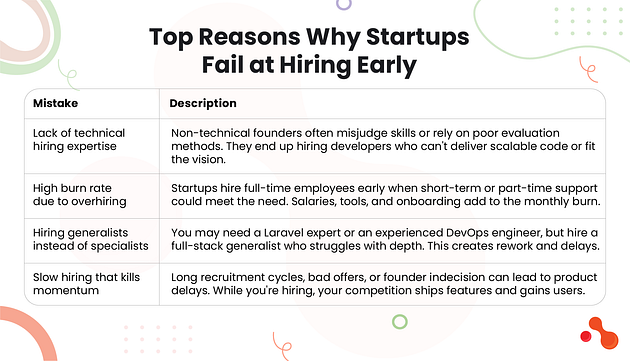
Top Reasons Why Startups Fail at Hiring Early

Startups often move fast, but hiring too fast can kill their momentum. The pressure to scale quickly often leads to shortcuts in recruitment, resulting in costly missteps. Below are the most common early hiring problems in startups that derail progress before real traction begins!

https://miro.medium.com/v2/resize:fit:720/format:webp/1*DLz4LTOkx-Nrr9nQK_XDEg.png 720w, https://miro.medium.com/v2/resize:fit:750/format:webp/1*DLz4LTOkx-Nrr9nQK_XDEg.png 750w, https://miro.medium.com/v2/resize:fit:786/format:webp/1*DLz4LTOkx-Nrr9nQK_XDEg.png 786w, https://miro.medium.com/v2/resize:fit:828/format:webp/1*DLz4LTOkx-Nrr9nQK_XDEg.png 828w, https://miro.medium.com/v2/resize:fit:1100/format:webp/1*DLz4LTOkx-Nrr9nQK_XDEg.png 1100w, https://miro.medium.com/v2/resize:fit:1400/format:webp/1*DLz4LTOkx-Nrr9nQK_XDEg.png 1400w" type="image/webp" sizes="(min-resolution: 4dppx) and (max-width: 700px) 50vw, (-webkit-min-device-pixel-ratio: 4) and (max-width: 700px) 50vw, (min-resolution: 3dppx) and (max-width: 700px) 67vw, (-webkit-min-device-pixel-ratio: 3) and (max-width: 700px) 65vw, (min-resolution: 2.5dppx) and (max-width: 700px) 80vw, (-webkit-min-device-pixel-ratio: 2.5) and (max-width: 700px) 80vw, (min-resolution: 2dppx) and (max-width: 700px) 100vw, (-webkit-min-device-pixel-ratio: 2) and (max-width: 700px) 100vw, 700px" />https://miro.medium.com/v2/resize:fit:720/1*DLz4LTOkx-Nrr9nQK_XDEg.png 720w, https://miro.medium.com/v2/resize:fit:750/1*DLz4LTOkx-Nrr9nQK_XDEg.png 750w, https://miro.medium.com/v2/resize:fit:786/1*DLz4LTOkx-Nrr9nQK_XDEg.png 786w, https://miro.medium.com/v2/resize:fit:828/1*DLz4LTOkx-Nrr9nQK_XDEg.png 828w, https://miro.medium.com/v2/resize:fit:1100/1*DLz4LTOkx-Nrr9nQK_XDEg.png 1100w, https://miro.medium.com/v2/resize:fit:1400/1*DLz4LTOkx-Nrr9nQK_XDEg.png 1400w" sizes="(min-resolution: 4dppx) and (max-width: 700px) 50vw, (-webkit-min-device-pixel-ratio: 4) and (max-width: 700px) 50vw, (min-resolution: 3dppx) and (max-width: 700px) 67vw, (-webkit-min-device-pixel-ratio: 3) and (max-width: 700px) 65vw, (min-resolution: 2.5dppx) and (max-width: 700px) 80vw, (-webkit-min-device-pixel-ratio: 2.5) and (max-width: 700px) 80vw, (min-resolution: 2dppx) and (max-width: 700px) 100vw, (-webkit-min-device-pixel-ratio: 2) and (max-width: 700px) 100vw, 700px" data-testid="og" />
Top Reasons Why Startups Fail at Hiring Early

Inside story: These startup hiring mistakes happen because early-stage founders lack time, resources, or the network to build the right team quickly. That’s why they need faster and more flexible ways to access top talent!

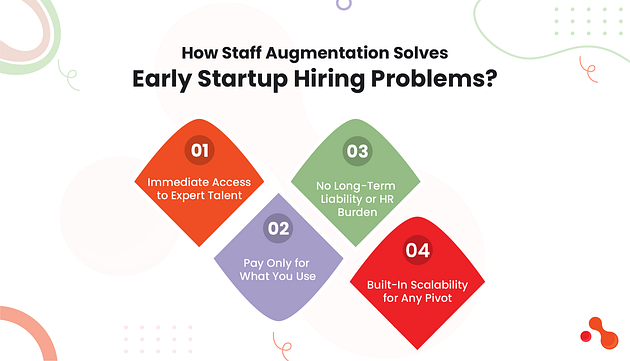
How Staff Augmentation Solves Early Startup Hiring Problems?

https://miro.medium.com/v2/resize:fit:720/format:webp/1*GfDQ7gGhh9utbP021WQxUQ.png 720w, https://miro.medium.com/v2/resize:fit:750/format:webp/1*GfDQ7gGhh9utbP021WQxUQ.png 750w, https://miro.medium.com/v2/resize:fit:786/format:webp/1*GfDQ7gGhh9utbP021WQxUQ.png 786w, https://miro.medium.com/v2/resize:fit:828/format:webp/1*GfDQ7gGhh9utbP021WQxUQ.png 828w, https://miro.medium.com/v2/resize:fit:1100/format:webp/1*GfDQ7gGhh9utbP021WQxUQ.png 1100w, https://miro.medium.com/v2/resize:fit:1400/format:webp/1*GfDQ7gGhh9utbP021WQxUQ.png 1400w" type="image/webp" sizes="(min-resolution: 4dppx) and (max-width: 700px) 50vw, (-webkit-min-device-pixel-ratio: 4) and (max-width: 700px) 50vw, (min-resolution: 3dppx) and (max-width: 700px) 67vw, (-webkit-min-device-pixel-ratio: 3) and (max-width: 700px) 65vw, (min-resolution: 2.5dppx) and (max-width: 700px) 80vw, (-webkit-min-device-pixel-ratio: 2.5) and (max-width: 700px) 80vw, (min-resolution: 2dppx) and (max-width: 700px) 100vw, (-webkit-min-device-pixel-ratio: 2) and (max-width: 700px) 100vw, 700px" />https://miro.medium.com/v2/resize:fit:720/1*GfDQ7gGhh9utbP021WQxUQ.png 720w, https://miro.medium.com/v2/resize:fit:750/1*GfDQ7gGhh9utbP021WQxUQ.png 750w, https://miro.medium.com/v2/resize:fit:786/1*GfDQ7gGhh9utbP021WQxUQ.png 786w, https://miro.medium.com/v2/resize:fit:828/1*GfDQ7gGhh9utbP021WQxUQ.png 828w, https://miro.medium.com/v2/resize:fit:1100/1*GfDQ7gGhh9utbP021WQxUQ.png 1100w, https://miro.medium.com/v2/resize:fit:1400/1*GfDQ7gGhh9utbP021WQxUQ.png 1400w" sizes="(min-resolution: 4dppx) and (max-width: 700px) 50vw, (-webkit-min-device-pixel-ratio: 4) and (max-width: 700px) 50vw, (min-resolution: 3dppx) and (max-width: 700px) 67vw, (-webkit-min-device-pixel-ratio: 3) and (max-width: 700px) 65vw, (min-resolution: 2.5dppx) and (max-width: 700px) 80vw, (-webkit-min-device-pixel-ratio: 2.5) and (max-width: 700px) 80vw, (min-resolution: 2dppx) and (max-width: 700px) 100vw, (-webkit-min-device-pixel-ratio: 2) and (max-width: 700px) 100vw, 700px" data-testid="og" />
How Staff Augmentation Solves Early Startup Hiring Problems?

When traditional hiring slows you down or drains your runway, staff augmentation for startups offers a smarter alternative. It fixes early hiring failures by offering speed, control, and flexibility, without the overhead of building an in-house team.

Immediate Access to Expert Talent

With staff augmentation, startups can instantly onboard skilled professionals who already know how to build and ship. Whether you need remote MVP developers for hire or a Laravel specialist for a backend module, you get results without going through months of interviews.

Pay Only for What You Use

You can hire on an hourly or monthly basis. There’s no wasted spend on idle capacity or bloated salaries. This model ensures cost efficiency at every stage of product development.

No Long-Term Liability or HR Burden

Forget about contracts, employee benefits, taxes, or compliance issues. Augmented staff work under flexible agreements, and you’re free to scale down with no HR bottlenecks.

Built-In Scalability for Any Pivot

Your startup may pivot, scale up suddenly, or face funding delays. Staff augmentation lets you adjust resources instantly. You can add more developers or reduce bandwidth as priorities change, without harming velocity or morale. The benefits of staff augmentation are clear: it lets you move fast, stay lean, and build smarter from day one.

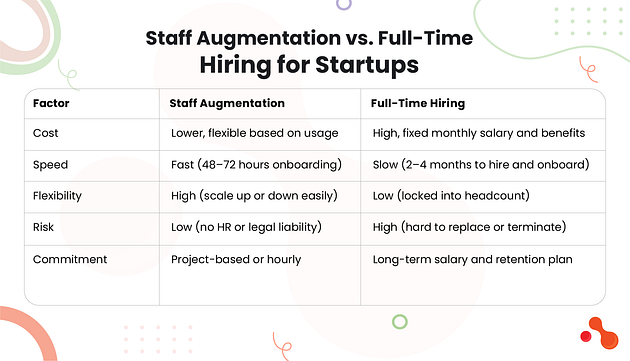
Staff Augmentation vs. Full-Time Hiring for Startups

When building a team, startup founders must weigh flexibility, cost, and speed. Comparing staff augmentation for startups with full-time hiring reveals how vastly different the impact can be on resources and execution.

https://miro.medium.com/v2/resize:fit:720/format:webp/1*vG2DU2qaS5IPWcZ0GoSBVQ.png 720w, https://miro.medium.com/v2/resize:fit:750/format:webp/1*vG2DU2qaS5IPWcZ0GoSBVQ.png 750w, https://miro.medium.com/v2/resize:fit:786/format:webp/1*vG2DU2qaS5IPWcZ0GoSBVQ.png 786w, https://miro.medium.com/v2/resize:fit:828/format:webp/1*vG2DU2qaS5IPWcZ0GoSBVQ.png 828w, https://miro.medium.com/v2/resize:fit:1100/format:webp/1*vG2DU2qaS5IPWcZ0GoSBVQ.png 1100w, https://miro.medium.com/v2/resize:fit:1400/format:webp/1*vG2DU2qaS5IPWcZ0GoSBVQ.png 1400w" type="image/webp" sizes="(min-resolution: 4dppx) and (max-width: 700px) 50vw, (-webkit-min-device-pixel-ratio: 4) and (max-width: 700px) 50vw, (min-resolution: 3dppx) and (max-width: 700px) 67vw, (-webkit-min-device-pixel-ratio: 3) and (max-width: 700px) 65vw, (min-resolution: 2.5dppx) and (max-width: 700px) 80vw, (-webkit-min-device-pixel-ratio: 2.5) and (max-width: 700px) 80vw, (min-resolution: 2dppx) and (max-width: 700px) 100vw, (-webkit-min-device-pixel-ratio: 2) and (max-width: 700px) 100vw, 700px" />https://miro.medium.com/v2/resize:fit:720/1*vG2DU2qaS5IPWcZ0GoSBVQ.png 720w, https://miro.medium.com/v2/resize:fit:750/1*vG2DU2qaS5IPWcZ0GoSBVQ.png 750w, https://miro.medium.com/v2/resize:fit:786/1*vG2DU2qaS5IPWcZ0GoSBVQ.png 786w, https://miro.medium.com/v2/resize:fit:828/1*vG2DU2qaS5IPWcZ0GoSBVQ.png 828w, https://miro.medium.com/v2/resize:fit:1100/1*vG2DU2qaS5IPWcZ0GoSBVQ.png 1100w, https://miro.medium.com/v2/resize:fit:1400/1*vG2DU2qaS5IPWcZ0GoSBVQ.png 1400w" sizes="(min-resolution: 4dppx) and (max-width: 700px) 50vw, (-webkit-min-device-pixel-ratio: 4) and (max-width: 700px) 50vw, (min-resolution: 3dppx) and (max-width: 700px) 67vw, (-webkit-min-device-pixel-ratio: 3) and (max-width: 700px) 65vw, (min-resolution: 2.5dppx) and (max-width: 700px) 80vw, (-webkit-min-device-pixel-ratio: 2.5) and (max-width: 700px) 80vw, (min-resolution: 2dppx) and (max-width: 700px) 100vw, (-webkit-min-device-pixel-ratio: 2) and (max-width: 700px) 100vw, 700px" data-testid="og" />
Staff Augmentation vs. Full-Time Hiring for Startups

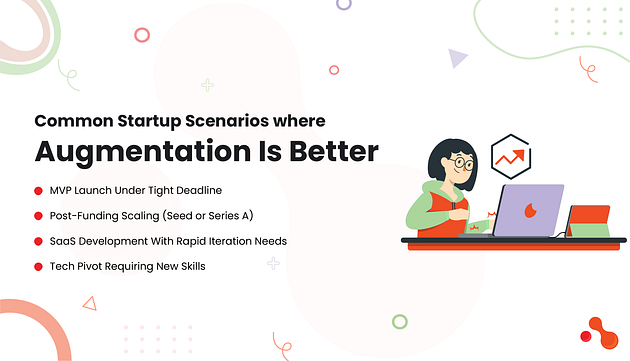
Common Startup Scenarios Where Augmentation Is Better

Startups operate in high-pressure environments where speed, talent, and timing define success. In many cases, staff augmentation for startups outperforms traditional hiring by solving urgent needs with immediate expertise.

https://miro.medium.com/v2/resize:fit:720/format:webp/1*kSPHIgy6eQ--0Kw3ineQQQ.png 720w, https://miro.medium.com/v2/resize:fit:750/format:webp/1*kSPHIgy6eQ--0Kw3ineQQQ.png 750w, https://miro.medium.com/v2/resize:fit:786/format:webp/1*kSPHIgy6eQ--0Kw3ineQQQ.png 786w, https://miro.medium.com/v2/resize:fit:828/format:webp/1*kSPHIgy6eQ--0Kw3ineQQQ.png 828w, https://miro.medium.com/v2/resize:fit:1100/format:webp/1*kSPHIgy6eQ--0Kw3ineQQQ.png 1100w, https://miro.medium.com/v2/resize:fit:1400/format:webp/1*kSPHIgy6eQ--0Kw3ineQQQ.png 1400w" type="image/webp" sizes="(min-resolution: 4dppx) and (max-width: 700px) 50vw, (-webkit-min-device-pixel-ratio: 4) and (max-width: 700px) 50vw, (min-resolution: 3dppx) and (max-width: 700px) 67vw, (-webkit-min-device-pixel-ratio: 3) and (max-width: 700px) 65vw, (min-resolution: 2.5dppx) and (max-width: 700px) 80vw, (-webkit-min-device-pixel-ratio: 2.5) and (max-width: 700px) 80vw, (min-resolution: 2dppx) and (max-width: 700px) 100vw, (-webkit-min-device-pixel-ratio: 2) and (max-width: 700px) 100vw, 700px" />https://miro.medium.com/v2/resize:fit:720/1*kSPHIgy6eQ--0Kw3ineQQQ.png 720w, https://miro.medium.com/v2/resize:fit:750/1*kSPHIgy6eQ--0Kw3ineQQQ.png 750w, https://miro.medium.com/v2/resize:fit:786/1*kSPHIgy6eQ--0Kw3ineQQQ.png 786w, https://miro.medium.com/v2/resize:fit:828/1*kSPHIgy6eQ--0Kw3ineQQQ.png 828w, https://miro.medium.com/v2/resize:fit:1100/1*kSPHIgy6eQ--0Kw3ineQQQ.png 1100w, https://miro.medium.com/v2/resize:fit:1400/1*kSPHIgy6eQ--0Kw3ineQQQ.png 1400w" sizes="(min-resolution: 4dppx) and (max-width: 700px) 50vw, (-webkit-min-device-pixel-ratio: 4) and (max-width: 700px) 50vw, (min-resolution: 3dppx) and (max-width: 700px) 67vw, (-webkit-min-device-pixel-ratio: 3) and (max-width: 700px) 65vw, (min-resolution: 2.5dppx) and (max-width: 700px) 80vw, (-webkit-min-device-pixel-ratio: 2.5) and (max-width: 700px) 80vw, (min-resolution: 2dppx) and (max-width: 700px) 100vw, (-webkit-min-device-pixel-ratio: 2) and (max-width: 700px) 100vw, 700px" data-testid="og" />
Common Startup Scenarios Where Augmentation Is Better

Here are real-world situations where augmentation makes more sense:

MVP Launch Under Tight Deadline

Launching an MVP often comes with fixed investor expectations and a short runway. Augmentation allows you to hire remote Laravel developers for startup projects within days, not months. This speeds up delivery without sacrificing code quality or team control.

Post-Funding Scaling (Seed or Series A)

Once funding arrives, startups need to scale fast. Instead of spending three months hiring, founders can bring in multiple developers on contract to accelerate product updates, feature rollouts, and architecture redesigns.

SaaS Development With Rapid Iteration Needs

SaaS startups must release updates regularly based on user feedback. Staff augmentation gives access to skilled developers who can build, test, and deploy in short sprints. You can avoid bottlenecks without inflating payroll!

Tech Pivot Requiring New Skills

When your product shifts from Web2 to Web3, or from monolith to microservices, your old team may not have the required skill set. Augment your core with specialists who bring that exact expertise without hiring full-time.

In all these cases, startups save time, money, and bandwidth by partnering with the best staff augmentation company for startups, one that understands early-stage urgency and tech specificity.

Real Startup Examples: Failing Fast vs. Scaling Smart

The following examples show how two early-stage startups took different paths, with drastically different outcomes.

❌ Startup A: Hired Fast, Burned Out Faster

Startup A raised a small seed round and rushed to build its MVP. The founder, with no technical background, hired a full-time in-house team of five developers in just four weeks. Without proper vetting or role clarity, they overbuilt features, missed critical deadlines, and created tech debt that slowed progress.

In six months, the startup burned over $300,000 in salaries, tools, and office space. No product shipped. Investors lost confidence. The company shut down before reaching the market.

✅ Startup B: Augmented Right, Launched on Time

Startup B, working with a similar budget, chose staff augmentation for startups. They brought in remote MVP developers for hire from a trusted agency. Instead of hiring full-time, they paid hourly for a project-based team via flexible model options.

Within five months, they launched a clean, functioning MVP. Their burn rate stayed low. They saved over 50% in upfront costs and secured follow-on funding after the product gained traction. These outcomes show the power of choosing the right hiring model.

How to Implement Staff Augmentation Strategically?

https://miro.medium.com/v2/resize:fit:720/format:webp/1*5z9sCy-nfwIYU1SpHNlQMQ.png 720w, https://miro.medium.com/v2/resize:fit:750/format:webp/1*5z9sCy-nfwIYU1SpHNlQMQ.png 750w, https://miro.medium.com/v2/resize:fit:786/format:webp/1*5z9sCy-nfwIYU1SpHNlQMQ.png 786w, https://miro.medium.com/v2/resize:fit:828/format:webp/1*5z9sCy-nfwIYU1SpHNlQMQ.png 828w, https://miro.medium.com/v2/resize:fit:1100/format:webp/1*5z9sCy-nfwIYU1SpHNlQMQ.png 1100w, https://miro.medium.com/v2/resize:fit:1400/format:webp/1*5z9sCy-nfwIYU1SpHNlQMQ.png 1400w" type="image/webp" sizes="(min-resolution: 4dppx) and (max-width: 700px) 50vw, (-webkit-min-device-pixel-ratio: 4) and (max-width: 700px) 50vw, (min-resolution: 3dppx) and (max-width: 700px) 67vw, (-webkit-min-device-pixel-ratio: 3) and (max-width: 700px) 65vw, (min-resolution: 2.5dppx) and (max-width: 700px) 80vw, (-webkit-min-device-pixel-ratio: 2.5) and (max-width: 700px) 80vw, (min-resolution: 2dppx) and (max-width: 700px) 100vw, (-webkit-min-device-pixel-ratio: 2) and (max-width: 700px) 100vw, 700px" />https://miro.medium.com/v2/resize:fit:720/1*5z9sCy-nfwIYU1SpHNlQMQ.png 720w, https://miro.medium.com/v2/resize:fit:750/1*5z9sCy-nfwIYU1SpHNlQMQ.png 750w, https://miro.medium.com/v2/resize:fit:786/1*5z9sCy-nfwIYU1SpHNlQMQ.png 786w, https://miro.medium.com/v2/resize:fit:828/1*5z9sCy-nfwIYU1SpHNlQMQ.png 828w, https://miro.medium.com/v2/resize:fit:1100/1*5z9sCy-nfwIYU1SpHNlQMQ.png 1100w, https://miro.medium.com/v2/resize:fit:1400/1*5z9sCy-nfwIYU1SpHNlQMQ.png 1400w" sizes="(min-resolution: 4dppx) and (max-width: 700px) 50vw, (-webkit-min-device-pixel-ratio: 4) and (max-width: 700px) 50vw, (min-resolution: 3dppx) and (max-width: 700px) 67vw, (-webkit-min-device-pixel-ratio: 3) and (max-width: 700px) 65vw, (min-resolution: 2.5dppx) and (max-width: 700px) 80vw, (-webkit-min-device-pixel-ratio: 2.5) and (max-width: 700px) 80vw, (min-resolution: 2dppx) and (max-width: 700px) 100vw, (-webkit-min-device-pixel-ratio: 2) and (max-width: 700px) 100vw, 700px" data-testid="og" />
How to Implement Staff Augmentation Strategically?

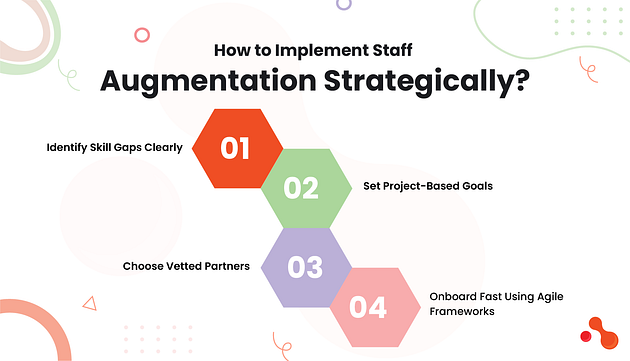
Choosing staff augmentation for startups works only when done with clarity and intent. You need to know what to build, who to bring in, and how to manage their output. Follow this strategic approach to make augmentation effective from day one!

Identify Skill Gaps Clearly

Start by auditing your current team.

Do you lack frontend capacity?

Need backend specialists like Laravel developers?

Or product designers for an MVP sprint?

Define exact roles and skills before reaching out for external help!

Set Project-Based Goals

Augmented developers perform best when assigned to specific outcomes. Don’t onboard them to “help the team.” Instead, tie each resource to milestones like a working prototype, API integration, or testing phase.

Choose Vetted Partners

Work with the best staff augmentation company for startups, one that understands tech stacks, agility, and startup pace. Agencies like Acquaint Softtech provide proven developers who can plug in fast, adapt to your tools, and build real products.

Onboard Fast Using Agile Frameworks

Use agile tools like Jira, Trello, or Asana for sprint planning. Assign Git access, set up Slack channels, and define standup routines. When you onboard right, remote engineers feel like part of the core team from day one.

Also read: Top ways IT staff augmentation empowers tech startups!

Bottomline

In the early stages of a startup, hiring decisions determine product velocity, cost efficiency, and long-term sustainability. Moving quickly is important, but making the right hiring developer choice is essential for survival. Full-time hiring at the wrong stage can lead to wasted capital, missed deadlines, and irreversible damage to growth momentum.

Staff augmentation for startups offers a strategic alternative. It allows founders to access specialized talent, reduce overhead, and scale operations based on real-time business needs. Instead of locking into fixed salaries, you gain the ability to allocate resources where they deliver the most value.

The most successful startups today prioritize flexibility, skill alignment, and speed. Staff augmentation supports all three, giving your venture the foundation to build fast, scale smart, and respond to change effectively.

Read more…

Introduction

While companies are eager to embrace cloud, AI, automation, and modern development frameworks, they struggle to find the right in-house resources quickly enough. This is where IT Staff Services steps in!

By offering access to pre-vetted, role-ready professionals, these services help organizations maintain momentum, meet deadlines, and align their tech stack with evolving business goals.

Whether it’s How to Hire Laravel Developers for building a SaaS MVP or assembling a DevOps squad to modernize legacy systems, IT staff services provide the right support model for scalable and sustainable digital growth.

What Are IT Staff Services?

IT Staff Services refers to a flexible hiring model that allows businesses to access skilled technology professionals without going through the traditional long-term hiring process. These services support various engagement types including full-time, part-time, project-based, and contract-based roles.

Instead of building internal teams from scratch, companies can quickly onboard remote experts to fill critical skill gaps. For instance, a startup building a web application might hire Laravel developers for backend development, bring in DevOps specialists for cloud deployment, or contract QA engineers to ensure product stability before launch.

Why Modern Businesses Need IT Staff Services?

Modern businesses operate in a rapidly evolving digital environment where technology advances at a breakneck speed. This creates an urgent need for specialized technical skills that in-house teams may not always possess or acquire quickly enough.

Rapid tech innovation needs specialized skills

Emerging technologies like AI, cloud-native systems, and modern frameworks such as Laravel and React require professionals with hands-on experience. IT Staff Services helps fill these gaps by offering access to specialists who are already trained and project-ready.

Cost of wrong or delayed hiring is too high

A wrong hire or extended vacancy in a key technical role can derail product timelines and increase costs. IT staffing solutions reduce this risk by allowing businesses to scale teams with vetted professionals who can contribute from day one.

Need for faster product launches and MVP iterations

Startups and product companies cannot afford to delay releases. With IT staff augmentation for startups, teams can quickly onboard developers or QA experts to support MVP builds, feature rollouts, or even last-minute sprints.

Key Benefits of IT Staff Services for Scaling Companies

As companies grow, resource needs shift rapidly. IT Staff Services offers the adaptability and expertise required to meet those demands without overextending internal teams.

Flexibility to expand or contract based on project phases

Projects often move through different stages: Ideation, Development, Testing, and Scaling.

With flexible tech hiring models, businesses can bring in skilled professionals when needed and scale down when the demand reduces. This avoids the long-term burden of full-time staffing.

Access to a broader, global talent pool

With the help of the best IT staffing companies in 2025, companies are no longer limited to hiring within their region. Whether you want to hire remote Laravel developers or DevOps experts, staff services help tap into a global network of vetted professionals.

Reduced operational overhead and risk

IT staff augmentation eliminates the need to invest heavily in infrastructure, employee benefits, or long onboarding cycles. It also reduces the risk of project delays due to unfilled positions or skill mismatches.

Specialized expertise without full-time commitment

Not every project requires a permanent hire. IT staff augmentation for startups and enterprises allows companies to access specific skills, such as cybersecurity, mobile development, or QA, only for the duration they are needed. This leads to better cost control and resource allocation.

How IT Staff Services Drive Digital Transformation?

Digital transformation requires rapid adaptation to emerging technologies, and IT Staff Services provides the technical agility businesses need to stay ahead in 2025.

Enable faster cloud migrations, app modernization, and AI integration

As businesses shift to the cloud and adopt technologies like AI and machine learning, they need skilled professionals who understand modern infrastructure. IT staffing solutions give companies access to experts who can handle complex transitions, from legacy system upgrades to AI-based automation.

Support DevOps adoption and Agile development

DevOps and Agile practices demand a high level of collaboration and iteration. With dedicated remote developers onboarded quickly, organizations can create reliable CI/CD pipelines, reduce deployment times, and improve team velocity.

Help startups pivot quickly based on market feedback

Startups often need to make product adjustments based on user behavior and changing market dynamics. Flexible tech hiring models allow them to onboard new specialists or restructure their teams without delay, helping them stay lean and responsive.

Types of IT Staff Services You Can Leverage

Businesses in 2025 have access to a range of IT Staff Services that align with their specific project goals, timelines, and budgets. These models provide the flexibility to hire on demand based on immediate or strategic business needs without long-term commitments.

Here’s a breakdown of the most common models and how they’re used in real scenarios:

13640426081?profile=RESIZE_710x

Common Challenges IT Staff Services Solve

Businesses often face a range of operational and technical hurdles when scaling. IT Staff Services help resolve some of the most pressing challenges:

In-House Team Burnout

As internal teams juggle multiple projects, deadlines, and support requests, burnout becomes inevitable. IT staffing helps offload tasks by adding external experts who can immediately support key workloads.

Tech Talent Shortage

Finding specialized talent for roles like Laravel development, AI engineering, or DevOps can delay projects. Staff services provide access to vetted professionals across global markets to fill gaps faster.

Faster Market Entry for New Products

Launch timelines often get extended due to resource limitations. With flexible staff augmentation, startups and enterprises can push MVPs or new features to production on time.

Specialized Technology Adoption

Emerging tech such as blockchain, AI, or serverless computing requires niche expertise. Staff services enable businesses to adopt these technologies without hiring full-time specialists.

Choosing the Right IT Staffing Partner: What to Look For?

Selecting the right partner for IT Staff Services is crucial to ensure productivity, reliability, and business growth. Here are the key traits to prioritize:

Certified Developers and Proven Experience

Look for companies with a track record of placing qualified developers, such as Laravel engineers, DevOps specialists, or QA testers. Technical certifications and successful case studies are strong indicators of capability.

48-Hour Onboarding Capabilities

Speed matters when your business needs to move quickly. The right staffing partner should offer fast turnaround times, ideally onboarding remote talent within 48 hours of project approval.

Sprint Planning and Agile Best Practices

Agile integration is vital for modern product teams. Ensure the staffing company can provide talent experienced in Agile workflows, sprint estimation, and iterative development cycles.

Transparent Pricing and Communication Processes

Clear contracts, defined engagement models, and proactive reporting are essential. A reliable partner will maintain ongoing visibility through tools like Jira, Slack, or Asana and offer pricing without hidden costs.

Real-World Success Stories: How Businesses Gained with Staff Services

Many scaling businesses across industries are actively leveraging IT Staff Services to meet growing demands, fill critical skill gaps, and accelerate delivery. Here are some real-world scenarios showing the practical benefits:

✅ Startup Scaling with IT Staff Augmentation for Startups

A healthtech startup in India needed to fast-track their MVP but lacked Laravel and QA expertise internally. By using IT staff augmentation for startups, they onboarded a dedicated remote team in 48 hours, including Laravel developers and testers. The result was a fully functioning MVP within 10 weeks, cutting development time by 40%.

✅ Mid-Sized SaaS Company Using Flexible Tech Hiring Models

A US-based SaaS product company turned to flexible tech hiring models to expand its backend capabilities without long-term hiring commitments. Through a top IT staffing solutions provider, they added DevOps engineers and AI experts for a 6-month sprint, improving performance and scalability.

✅ Ecommerce Enterprise Partnering with the Best IT Staffing Companies 2025

One of Europe’s leading e-commerce platforms modernized its outdated system using one of the best IT staffing companies in 2025. They hired remote Laravel developers and cloud architects to migrate their legacy app to a scalable Laravel-Vue-based system with automated deployments. This move helped improve uptime by 99.95%.

✅ Agency Hiring Dedicated Remote Developers for Client Projects

A digital agency in the UK needed to hire dedicated remote developers to handle seasonal workload spikes. Instead of building a full-time team, they used project-based IT staff services to onboard frontend specialists and WordPress developers. This ensured timely project delivery without increasing fixed payroll costs.

Bottomline

IT Staff Services offer a practical and efficient solution. Whether it's scaling teams for a new product launch, hiring remote Laravel developers, or adopting cloud and AI capabilities without full-time overhead, this model enables lean yet powerful delivery.

From IT staff augmentation for startups to flexible tech hiring models for enterprises, the benefits are measurable. Faster releases, stronger teams, and reduced costs are just the beginning. Businesses that embrace the right IT staffing solutions today are better positioned for growth, innovation, and operational resilience tomorrow. Now is the time to rethink hiring, unlock on-demand expertise, and scale with confidence!


Read more…

13584458069?profile=RESIZE_710x

In 2025, mobile-first WordPress optimization will become essential for site performance and user retention. A mobile-first design ensures your WordPress site loads fast, adapts to screen sizes, and maintains usability across all devices.


More than 59% of global website traffic comes from mobile devices, making performance optimization a non-negotiable factor. Optimizing a WordPress site for mobile goes beyond responsive design. It includes mobile WordPress speed optimization, asset compression, minimal code render-blocking, and effective caching setups via WordPress development tools


But who should handle your optimization?


You have two options 

  • agencies with structured workflows or 
  • freelancers with flexible engagement models.


Each approach brings a different perspective to hiring WordPress developers, and each impacts delivery, scalability, and speed in distinct ways. But the real question is:

Which one ensures better results for mobile-first WordPress optimization?


This blog compares both models side by side to help you decide what works best for your WordPress performance goals!

What is Mobile-First WordPress Development?

13584457895?profile=RESIZE_710x

Mobile-first WordPress development means building the mobile version of your site before the desktop version. It prioritizes loading speed, clean UI, and responsive interactions for smaller screens.


In WordPress, this starts with choosing a responsive theme and optimizing the layout to load critical mobile content first. Developers then enhance performance using techniques like image compression, lazy loading, and asynchronous scripts.


Why does this matter?

Mobile WordPress speed optimization directly affects user engagement and bounce rate. If your mobile site loads in over three seconds, most users leave.

Core Benefits of Mobile-First WordPress Development

  • Faster load times improve session duration and reduce bounce
  • Improved SEO performance, since Google prioritizes mobile-first indexing
  • Better user experience (UX) with simpler navigation and touch-first design


These benefits only work if the technical foundation supports them. That’s where key performance metrics come in.

Key Metrics for Performance Evaluation

  • LCP (Largest Contentful Paint): Measures how quickly the main content loads
  • CLS (Cumulative Layout Shift): Tracks how stable the layout remains during load
  • TTI (Time to Interactive): Gauges how fast a user can engage with content
  • Mobile PageSpeed Score: Google’s score based on technical and UX performance


Freelancers and agencies approach these metrics differently. The next section will show how.

Why Performance Optimization Matters in Mobile-First?

13584458093?profile=RESIZE_710x

In a mobile-first world, performance optimization drives both visibility and conversions. Google now uses mobile-first indexing by default, meaning it evaluates your site’s mobile version before the desktop version.


If your WordPress site performs poorly on mobile, it won’t rank, regardless of how strong your desktop version looks. This is where mobile-first WordPress optimization makes a measurable difference.

Mobile Performance = SEO Performance

Google’s Core Web Vitals LCP, CLS, and TTI are major ranking factors.

A slow-loading mobile page fails these metrics and drops in search results.


Also, a poor mobile WordPress speed optimization strategy directly impacts the PageSpeed score, which lowers ranking potential further. A trustworthy WordPress website development company would help you solve the complications well!

Mobile Bounce Rates Are Brutal

Studies show that mobile users are 32% more likely to bounce than desktop users when a site is slow or unstable. If your mobile site loads in over three seconds, 53% of users abandon it before interacting.

What Poor Optimization Looks Like on Mobile?

  • Fonts are too small or hard to tap
  • Layout shifts while loading
  • Unoptimized images are slowing the page
  • Mobile menus failing on tap
  • Content blocked by interstitials or banners
  • Delays in response after a click


Whether you hire WordPress developers via an agency or freelance, their ability to handle these issues determines your site's mobile success.

Freelance WordPress Developers: Strengths & Limitations

Freelance WordPress developers offer a flexible and cost-effective solution for businesses aiming to implement mobile-first WordPress optimization. Their adaptability and specialized skills can be particularly beneficial for projects with specific performance goals.

Strengths

Cost-Effective for Small Projects

Freelancers often provide competitive rates, making them suitable for startups and small businesses seeking mobile WordPress speed optimization without extensive budgets.

Direct Communication and Agility

Working directly with a freelancer allows for quick decision-making and rapid implementation of changes, essential for iterative optimization processes.

Specialized Expertise

Many freelancers focus on niche areas. For instance, some specialize in enhancing mobile performance metrics like LCP and TTI, crucial for mobile-first WordPress optimization.

Limitations

Limited QA and Testing Resources

Freelancers may lack access to a wide range of devices and testing tools, potentially impacting the thoroughness of mobile optimization.

Single Point of Failure

Relying on one individual can pose risks if they become unavailable, affecting project continuity.

Potential Lack of Long-Term Support

Some freelancers may not offer ongoing maintenance, which is vital for sustained performance and security.

Real-World Example

A U.S.-based digital agency reduced development costs by 40% by hiring a skilled WordPress developer from India. The freelancer delivered a mobile-optimized site that met the agency's performance standards, demonstrating the potential benefits of this approach.

WordPress Development Agencies: Strengths & Limitations

13584458482?profile=RESIZE_710x

Partnering with a WordPress development agency can be a strategic move for businesses aiming for mobile-first WordPress optimization. Agencies offer a comprehensive approach, combining diverse expertise to deliver robust and scalable solutions.

Strengths

Team-Based Approach

Agencies bring together frontend and backend developers, QA testers, and SEO specialists. This collaborative environment ensures that every aspect of your WordPress site is optimized for performance and user experience.

Access to Advanced Tools and Device Labs

Agencies often have access to a wide range of devices and testing tools, enabling thorough mobile WordPress speed optimization across various platforms and screen sizes.

Reliability in Handling Complex Projects

For large-scale or intricate projects, agencies provide structured processes and project management, reducing the risk of delays and ensuring consistent quality.

Limitations

Higher Cost

The comprehensive services offered by agencies come at a premium, which may not be feasible for smaller businesses or startups.

Slower Execution Due to Structured Processes

Agencies follow established workflows, which can sometimes lead to longer timelines for project completion.

Less Flexibility for Quick Updates

Making rapid changes or updates can be challenging due to the layered approval processes within agencies.

Real-World Example

Seahawk Media is a white-label WordPress agency that has successfully partnered with over 1,000 brands, including Alibaba. They specialize in delivering high-performance WordPress websites, offering services like custom theme development, plugin integration, and site speed optimization. Their structured approach ensures consistent quality and scalability for clients.

Comparison Table: Freelancers vs Agencies for Mobile-First Performance

When planning mobile-first WordPress optimization, businesses often compare freelancers with agencies based on delivery speed, cost, and scalability. Whether you aim to hire WordPress developers or partner with WordPress experts for hire, this comparison below helps set realistic expectations for mobile-first delivery.


Criteria

Freelancers

Agencies

Speed Optimization

Varies by individual skill

Consistent due to dedicated teams

Mobile Testing

Often limited to emulators

Multi-device lab access

Cost

More affordable

Higher due to team-based delivery

Scalability

Limited by the individual

Team can scale with project growth

Project Management

Informal or ad hoc

Structured with defined milestones


Freelancers may excel in mobile WordPress speed optimization when the task is niche and lightweight. However, agencies ensure a complete performance cycle from testing to deployment. It is ideal for high-traffic or growth-driven WordPress projects.

Use Case Scenarios: Who Should Choose What?

13584458295?profile=RESIZE_710x

Not every project needs a large team, and not every freelancer fits long-term goals. Choosing between WordPress experts for hire and agency partnerships depends on your site's scale, timeline, and technical needs.


Freelancers can help you hire WordPress developers quickly for focused work like mobile-first styling or image optimization.

Choose Freelancers If:

  • You manage a small WordPress website or personal blog
  • Your budget is limited, and the project scope is narrow
  • You need quick performance fixes or one-time mobile WordPress speed optimization
  • You prefer direct developer communication and fast iterations
  • Your site doesn’t require long-term maintenance or security layers


Agencies are ideal when performance goals tie into SEO, branding, and long-term reliability.

Choose Agencies If:

  • You operate a high-traffic WordPress website or a growing SaaS platform
  • You need ongoing performance monitoring and responsive support
  • You want a team with QA, DevOps, and SEO working together
  • Your site handles sensitive user data or eCommerce transactions
  • You need complete mobile-first WordPress optimization, from audit to delivery

Bottomline

In a mobile-first digital landscape, performance is no longer optional now. A fast-loading, well-optimized WordPress site directly impacts traffic, SEO, and conversions.


Whether you choose an agency or go with WordPress experts for hire, your decision must align with your project’s goals. It’s not about picking the cheaper option. It’s about choosing the right fit, support, and scalability for your mobile-first needs.


Use this simple checklist to make a clear decision:

Decision Checklist

  • Budget: Can you afford one-time or ongoing optimization support?
  • Scope: Is it a small update or a full mobile-first rebuild?
  • Tech Needs: Do you need specialized skills like mobile WordPress speed optimization or cross-device QA?
  • Timeline: Do you need a quick fix or long-term performance tracking?
  • Support: Will you need post-launch help and scalable resources?


Choosing the right path helps you hire WordPress developers who deliver speed, structure, and stability where it matters most!

Read more…
lead