I was researching about decision-making (again) recently and I came across this article by the late Dr Russell Ackoff, a “Systems Thinker”, called “Why few organisations adopt systems thinking”.
In the article Dr Ackoff writes about how organisations are naturally resistant to change and opines on our tendency to find a scapegoat when things go wrong from something we have done, although we seldom need to find a scapegoat for something we did not do.
Ackoff says: “The deterioration and failu
All Posts (6979)
Sort by
I was planning from a long time to provide you with some initial information regarding intellectual property protection in Bulgaria. Well, finally the time to do this has come.
Lets first answer to a question – What actually is Intellectual Property? (for these that don’t know).
An objects of intellectual property rights are intangible assets with economic value, expressed in a manner and an objective form, set out in a legal rule, which primarily are the result of creative activity.
In national, i
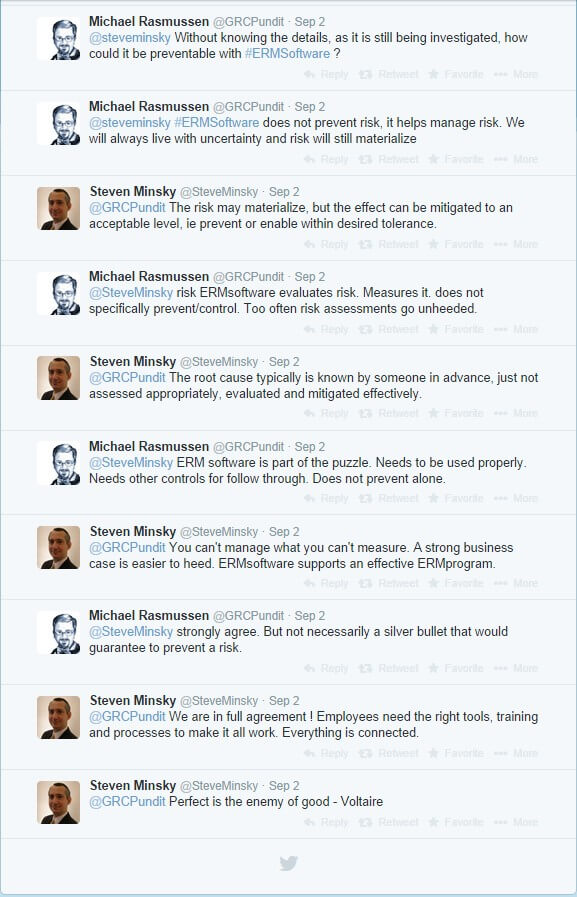
Home Depot hacked. http://t.co/qZROzHKWr2. This #risk preventable with #ERMSoftware. So why are ERM Programs failing? http://t.co/gcbLO6wCjz
-- Steven Minsky (@SteveMinsky) September 2, 2014
The goal of an ERM program is to put your organization in the best position to manage uncertainty, and to provide transparency into areas of vulnerability so businesses can make better decisions. Risk Management Software supports that process by providing insights and analytics that aren't obvious to the front
RMB (renminbi) is poised to broaden its reach and influence as a true global currency. China is establishing its first official Europe-based renminbi clearing bank in London, after a recent visit of the Chinese Premier to the UK. A number of other new locations are set to follow suit. What does this expansion mean for global transaction banks?

Hong Kong and Singapore are the busiest financial centres able to trade, convert or settle in RMB. By adding London to the official PBOC (People’s Bank of
 In Malcolm Gladwell’s “Blink,” he examines a hospital whose team had learned that to diagnose heart attacks, it’s more beneficial to gather a few key indicators than to try and take every measure into account. I’ve found that to judge the health of ERM programs, there are also a subset of characteristics that seem to immediately indicate success.
- Does the ERM program engage the front lines?
- Can the program analyze information across silos?
- Has the program engaged, or integrated, with at least one o
In its April 2014 review of RDR implementation, the FCA highlighted its aims to make the market more competitive in favour of consumers. What steps should execution-only brokers take to address those aims, before regulation is imposed, to get ahead of competition and gain customer loyalty and trust?
The review - ‘Supervising retail investment firms: being clear about adviser charges and services’, TR 14/6 – focused on helping customers make informed choices and ensure that advice is provided base
Why the cloud? At first glance the advantages to financial institutions are clear: lower costs, faster reactions to competitors and regulators, and improved communication with counterparties, for seamless transaction execution.
Even though the financial services industry has been slow to embrace cloud (mainly due to security concerns), adoption is accelerating. The numbers speak for themselves. Global business spending for infrastructure and services related to the cloud was $78.2bn in 2011. This
As a Trusted Advisor in Risk do you focus on all the decisions the business is making or do you focus on the big issues?
I bet you thought to yourself, of course I focus on the big issues, they are the ones that count.
Now, what if I asked you, “as a Trusted Advisor in Risk, do you VALUE all of the decisions the business is making or do you only focus on the big issues?” Now you are saying to yourself, “of course I value all of the decisions and I value the bigger ones more than the smaller one
According to a new study by GMI Ratings, bigger isn’t always better in the boardroom. In research for the Wall Street Journal, analysts found that large companies with the smallest boards produced substantially better shareholder returns. Based on a study of 400 companies with a market capitalization of at least $10 billion, those with small boards outperformed their peers by 8.5 percentage points, while those with large boards underperformed peers by 10.85 percentage points. The smallest bo |

Risk data is an area that has been largely overlooked for many years. Today the situation is different and the area is facing increasing regulatory scrutiny, as Systemically Important Financial Institutions (SIFIs) rush to comply with the Basel 239 Principles for Effective Risk Data Aggregation and Risk Reporting. An enterprise’s success depends on its ability to analyze risk data efficiently and effectively, in ways that uncover both risks and opportunities. Being able to extract and escalate c
Starting January 1, 2015, insurers across the United States are subject to a National Association of Insurance Commissioners (NAIC) model law requiring them to annually submit an Own Risk and Solvency Assessment (ORSA). ORSA is a self-assessment of sorts, requiring large and medium-size insurance groups* to report on their current and future risk management process.
ORSA Model Act outlines a few basic dimensions on which insurers will be analyzed. They include (1) effectiveness of risk management
Reputational Risk Draws Increased Board Awareness, But Not Action
In its fifth annual board of directors survey, "Concerns About Risks
Confronting Boards," EisnerAmper surveyed directors serving on the boards of more than 250 publicly traded, private, not-for-profit, and private equity-owned companies to find out what is being discussed in American boardrooms and, in turn, what those boards are accomplishing as a result.
“The financial cost and damage to reputation from a cyber/privacy breac
Introduction to Risk provides an introduction to the key risk, business resilience, and internal audit procedures issues facing banking professionals. It provides an understanding of risk assessment including operational risk, risk identification, risk assessment, risk mitigation, risk monitoring and control.
 It details the nature and importance of third party risk policies, understanding the concept of a model risk policy and business resilience. It also covers the importance of business contin
This Business Continuity Guide is contributed by our member Roland Teo
Contingency Planning for Infectious Disease Pandemics (4th version Mar 2014) Something to guide enterprises to prepare for MERS http://lnkd.in/b3_JmDa
I was reading a recent article from Knowledge@Wharton called “It’s Worth What!? Pressure-testing Companies with Sky-high Valuations” based on a book by Derek Lidow about Startups and what leadership style is needed at which point. So if you are a stock market punter it is worth a full read.
I was attracted to the article because I remember oh so well the dot.com to dot.bomb era at the turn of the century (doesn’t that sound like a long time ago?) and I have been fascinated with valuations of com
Despite reports that more than 65% of organizations have adopted Enterprise Risk Management, executives remain unimpressed and skeptical of the value their ERM programs are providing versus what is needed.
A new report by APQC finds that fewer than 1 in 5 executives say their companies are effectively managing emerging risk, and the report's authors worry that "Companies may be 'checking the boxes' that say they have processes to monitor strategic risks."[1]
Additionally, two in three companies sa
From a cold start to a bright future in less than six years! In 2008, a well-respected analyst house reported that “Europeans show little interest in contactless payments”. However, in 2013-2014, the two biggest card associations confirmed that contactless transactions had trebled and that spending had increased six-fold. So who is successful and why?
Let’s look at why contactless – CL - payments have the potential to reach a wide audience. First and foremost there are clear benefits for the thre
An interesting request came through from one of our customers today and is worth sharing on the Causal Capital blog because a lot of risk practitioners struggle with some of the more complex areas of modelling uncertainty. This is especially the case when risk managers are attempting to assess the size of impacts from catastrophes.
In this presentation and video, we unravel Extreme Value Theory [LINK]
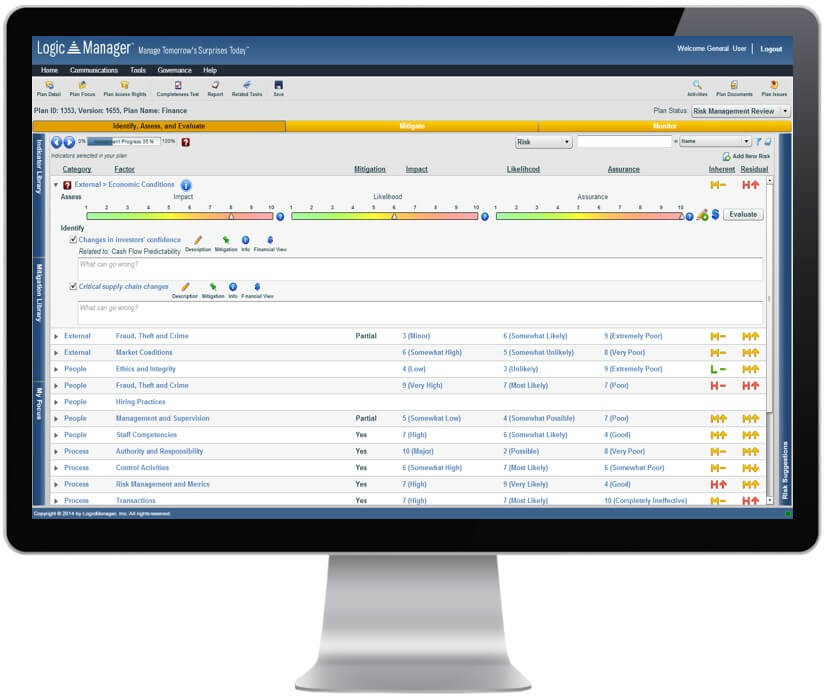 Once SharePoint has taken root in a company, there’s a tendency to try to use it for everything. The mega-popular platform can accomplish many use cases, from social networking to document management. It’s no wonder then that Risk Managers have been asked to build their programs on SharePoint - and live and die with the consequences. If your organization is considering SharePoint for ERM or other governance activity, or you’re considering moving your program off SharePoint all together, consider
If you have attended a workshop or speech of mine in the last 10 years you may well have been exposed to my version of the risk management journey for organisations from Vulnerable to Resilient. I portray the journey using an S-Curve, as shown here:
The nature of an S-Curve is that it is relatively easy to run up the middle of the curve, however, it is difficult to move up the last 20% or so. So it is for organisations in their risk management journey and so it is for Risk Advisors in organisat

