|
||
|
||
A B C D |
All Posts (6597)
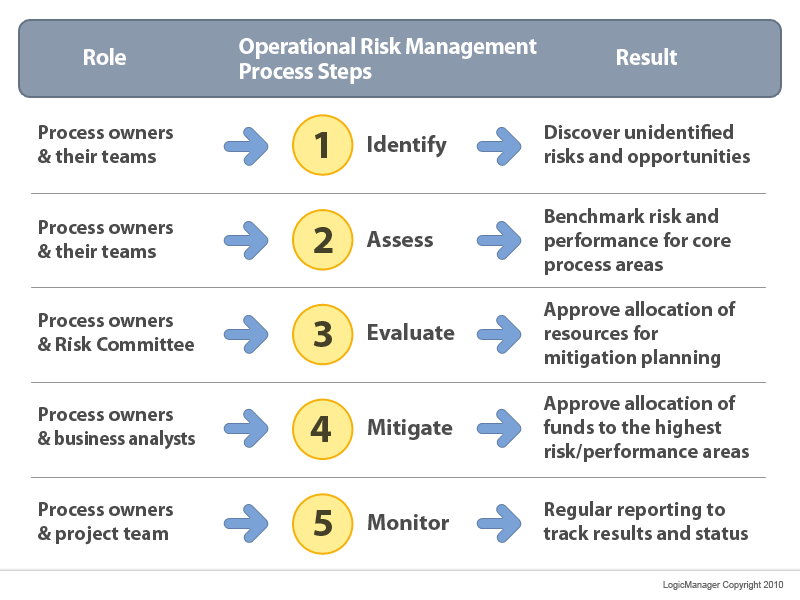
Risk management solutions are not a separate module or product. Instead, they compose an approach that adds value to both top-down and bottom-up activities within the organization.
Risk management is in everyone's job description and ERM is all about how to identify the aspect of risk management in every role and connect the dots automatically using the “Six Degrees of Separation Theory” that I discussed in my last blog to get right to the people who know the risk and are responsible for the risk
From one passionate Project Manager to another. For all you Risk Management evangelists out there, my next blog posts will help you understand the Risk Management Process. These posts will contain several short and sweet parts where I will give some practical implementation of the theory.
Why Risk Management is necessary for Projects?
Many, many projects fail? Why? It’s got to be scope creep, schedule delays, cost overrun, poor quality and/or customer dissatisfaction right? No. Not really – thes
Developed multiple financial arbitrages that allowed me to invest in the financial markets without risk. Produced a business model for the arbitrage, that is ready to be implemented. This model applies to all business sectors.
The model allows the buyer to purchase any product or service and receive a 100% rebate, and possible to have all their financed payment's made for them.
Based on the production of approx. 40% return from arbitrage. Based on What I produced over 7yrs.
Need to mark up a
Douglas Hubbard, in his book "The Failure of Risk Management", claims that risk management failed us in the lead up to the GFC because of flawed risk models, the use of qualitative risk assessment through the use of risk matrices or both. He contends that anything can be measured and that we should be measuring.
The case for quantification
There is no doubt in my mind that quantification is better than using our best judgement because our minds are at the mercy of our psychological biases. A coup
While Voluntary/Worksite benefits have been around for years - I started getting my feet wet in 1986 - the number of "Choices" in Carriers and Plans has grown dramatically! There's more Demand, more Choices, and more Responsibilities!
Let's start with some simple Tips for Brokers - The Dos, Don'ts and Things to Remember!
- Do - Team-Up! If you are not a Broker familiar with the complexities of the Voluntary/Worksite Market, consider teaming-up with a Specialist - preferably not a captive or semi-
Occasionally the SEC and other regulators will castigate, actually punish, fraudulent events on Wall Street. Of course the real punishment is only meted out to individuals and small companies. Mega banks – the banking mafia – are largely immune.
Martha Stewart was convicted of insider trading in 2004 – a relatively small amount – and was sent to jail. It was an act of fraud alright, but it pales in comparison to the fraud of Wall Street banks.
Phil Falcone, a once high flying hedge fund mana
Effective governance requires changes in the way risks are managed across "stove-pipes" or "business silos". More often than not, when loss events occur it becomes clear after the fact that different silos were holding onto different pieces of the risk puzzle but no one could put the pieces together. So the problem is how to identify risk?
Many risk managers are so bogged down by loss event capture and incident management, that being able to focus on preventing loss events and identifying emergi
The International Organisation for Standardization is about to enter into a trial review for its ISO 31004 guide. Meanwhile, the risk community is generally aware of what it seems to struggle with and the world of risk knows that certain aspects of risk management are simply not verbose enough in ISO 31000.
So then, perhaps it's time to write up our own ISO 31004 wishlist for solving the Achilles' Heel in ISO 31000.
The 50 wishes for ISO 31004 can be viewed by clicking this link
- Why a lack of a business continuity plan, means business agility, and competitive advantage are all endangered.
- Learn how many IPv6 adoption goals are actually low-risk, low-cost and how numerous organizations are already making significant progress.
- Learn a step by step methodology that can help organizations overcome inertia a
We define risk as "the effect of uncertainty on objectives" (ISO 31000), however how often do we stop and ask if we have the right objectives in the first place? On what basis were they formed? When were they developed? Have times changed? In my experience facilitating risk workshops, often a poor or even incorrect set of objectives is the "elephant in the room" for the management team. Here are some tips for ensuring you have the right objectives:
Stakeholder Analysis - Identify your stakeholde
The problems with risk models, a Bank of England speech on why financial models are broken and the general evolution of risk management.
Over the last few months, risk models have come under the spotlight as a potential reason why risk management, as an entire institutional function, is failing.
China may be once again beating us at our own game. But instead of ripping off American goods and producing them at a fraction of the cost, this time they’ve copied our monetary policy. And like everything the Chinese do, they are doing it big.
The Chinese government has been pumping the economy with liquidity by printing money at an alarming rate. Much of that money has ended up in the hands of wasteful state-owned enterprises, or SOEs lent to them by a banking cabal.
According the Motley Foo
The Partner Asset Facility
It is often said that the benefits of Risk Management are intangible. No argument here. It's tough to say "You were successful because I helped you manage your risk" when you are talking to an already successful CEO. How then do you demonstrate the benefits of Risk Management?
One approach is around the concept of Intellectual Capital. When we talk about the value of a business, we talk about book value and market value. The difference between book and market value is often described as the intan
Earlier on this year, the Bank for International Settlements released a paper which stated directly: "No macro stress test carried out ahead of the crisis identified the build-up of vulnerabilities"
This is a very harsh reality and highlights one of the key areas risk management needs to address. In this article we look at why stress testing risk systems hasn't been working for the banking sector.
First, what is Sarbanes-Oxley (SOX) 404 compliance? It is the legal requirement for public companies that senior management state that their company's financial reporting is accurate. Sounds simple? The expense and the value are all in the execution. How is that done? Simply put, the flow of information from the financial reports themselves is traced and connected to the activities that generate that information and the resources that are depended upon to generate that information. That sounds l
Fitch’s publication made the news in the Financial Times recently. An extra $566bn has been announced as the figure big banks will need to meet the tougher Basel III bank capital standards.
But how will financial institutions meet these steep capital requirements? Find out at Euromoney’s Basel III: The Resolution Conference.
Hear from commercial giants including Lloyds Banking Group, Rabobank, Commerzbank and Unicredit on their strategies for optimising capital in light of the Basel III guidelines
A recent debate on the ISO 31000 Linked in forum about time and risk poses the following question "Is delaying a risk considered a separate treatment method or is it just a sub-type of changing the likelihood?"
This is a very interesting statement and leads us to look at risk through time here in this blog.
Continue reading by following this link